Discover our courses

Further your passion to learn and develop in a learning community that is vibrant, challenging and caring.

View all courses

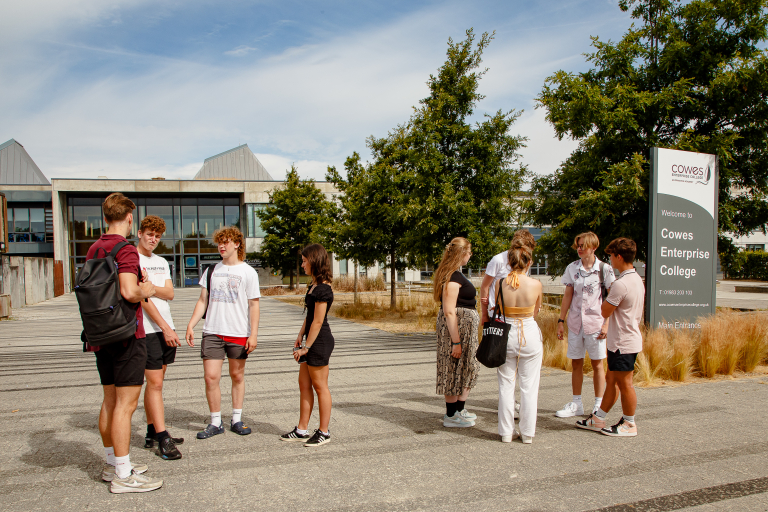
We believe that your sixth form experience is about more than your subject choices – it’s about the next chapter of your life, your journey to an exciting new world.

At Cowes Sixth Form we want to further your passion to learn and encourage your desire to explore and develop in a learning community that is vibrant, challenging and caring. 

Degrees in sciences, technology, engineering and maths are sometimes referred to as STEM degrees.

For these courses, universities often expect you to have studied specific subjects at A-level, or a specific combination of subjects. The sciences – chemistry, biology or physics – and maths, including further maths, are a good place to start.

Many STEM degrees fall into one of three disciplines: biological and life sciences, physical sciences (which includes engineering) and medicine, dentistry and veterinary sciences. 

Humanities degrees involve the study of human culture. English literature, history and philosophy are some examples.

Some courses may require you to have studied the subject at A-level, which is often the case with history and English literature. Others have no specific requirements but may suggest taking related subjects as good preparation.

Sometimes, universities want to see that you have built up your essay writing skills. It’s always best to check individual university requirements carefully. 

Social sciences include anthropology, business, economics, geography, law, politics and sociology. These degrees involve the study of human society and social relationships.

The topics social scientists study vary a lot, which means that subject requirements vary too. For example, maths may be considered good preparation for courses that involve frequent use of statistics, such as economics, but won’t be necessary for others.

For some social science degrees, such as geography, some universities may expect you to have taken the same subject at A-level. 

For most students, the study programme will comprise of:

  • Three advanced level courses (or four for some)
  • The Extended Project Qualification
  • Enrichment courses from the extended curriculum plus additional citizenship activities and other extension opportunities
  • Tutorial programme
  • Up to four charter periods

The opportunity to consider four advanced level subjects will be offered to students achieving a high admission score.


Course list

The study of life itself, A-level biology explores the theories and principles involved in living systems, in all their intricate beauty. Topics you will learn about include: lifestyle, transport, genes and health, development, plants and the environment, the natural environment and species survival, energy, exercise and co-ordination, as well as practical biology and research skills. By the end of the course you will know about the principles of genetics, molecules, taxonomy, natural selection, evolutionary theory, global warming, bacteria and viruses, and more.

Entry Requirements: GCSE grade 5 across subjects including English and maths. GCSE grade 6 in triple or double science. You must be prepared for background reading and consolidation.

​​​​​​​Specification: https://www.ocr.org.uk/qualifications/as-and-a-level/biology-a-h020-h420-from-2015/

A-level business introduces students to the fundamental principles of all business. You learn to analyse real life business case studies (Apple, Uber, Sainsbury, Dominoes…), write more general essays on business theories, calculate and compare business performance and even make business decisions.

Entry Requirements: GCSE grade 5 across subjects , ideally grade 6 English and maths.

Specification: https://qualifications.pearson.com/en/qualifications/edexcel-a-levels/business-2015.html

A-level chemistry shows a depth of learning that requires numerous skills of its students; maths, scientific reasoning, written and spoken communication and practicality among many others.

Entry Requirements: GCSE grade 5 across subjects including English and maths. GCSE grade 6 in triple or double science. You must be prepared for background reading and consolidation.

Specification: https://www.ocr.org.uk/qualifications/as-and-a-level/chemistry-a-h032-h432-from-2015/

Economics teaches how to think logically and use theories to understand how economies work. At the center of the subject is the question of how we divide up our scarce resources, and how these decisions affect us all – in other words who gets what and why? It is the study of our society, as well as the activities of various groups and institutions within it. This means studying the private sector and the effects of competition and then comparing this with the public provision. You will explore the world of Economic and financial issues in a highly practical way throughout this course.

Entry Requirements: GCSE grade 5 across subjects including English. GCSE grade 6 maths.

Specification: https://www.ocr.org.uk/qualifications/as-and-a-level/economics-h060-h460-from-2019/

A-level English literature specifications are designed to encourage the development of critical awareness and understanding of individual works of literature. You will also develop an understanding of relationships between texts and of the significance of cultural and contextual influences on readers and writers.

Entry Requirements: GCSE grade 5 across subjects including maths. GCSE grade 6 English literature and English language.

Specification: https://www.ocr.org.uk/qualifications/as-and-a-level/english-literature-h072-h472-from-2015/

Geography A-level is an exciting and engaging subject that enables you to explore popular and contemporary geographical themes and issues. You will study a range of physical geography topics such as tectonic processes, hazards and management techniques as well as issues such as water and energy insecurity and future water and energy conflicts. You will explore contemporary issues facing human geography and considers social, demographic, cultural and economic changes.

Entry Requirements: GCSE grade 5 across subjects including English and maths. GCSE grade 6 in geography. Students who have studied other humanities subjects or similar and who can demonstrate suitable abilities and aptitudes may be considered.

Specification: https://qualifications.pearson.com/en/qualifications/edexcel-a-levels/geography-2016.html

At Cowes, we study the AQA A-level history specification. Following recent reforms to the A-level curriculum, we offer two taught units:

  • The Tudors: England 1485-1603 (a breadth study)
  • The Cold War, c1946-1991

Entry requirements: GCSE grade 5 across subjects including English and maths. GCSE grade 6 in history, strong written communication skills, an enquiring and analytical mind and a desire to explore the past to understand the significance of historical events.

Specification:  https://www.aqa.org.uk/subjects/history/as-and-a-level/history-7041-7042

A-level Law is a thinking, writing, debating and learning subject. You need to be able to understand precision use of language, and to write clearly, and you will learn how to argue, on paper and in class, to develop and defend your views on how legal principles apply to specific situations.

Entry Requirements: GCSE grade 5 across subjects including maths, ideally GCSE grade 6 English.

Specification: https://www.aqa.org.uk/subjects/law/as-and-a-level/law-7162/changes-for-2022

In A-level Mathematics you will study proof, algebra and functions, coordinate geometry, sequences and series, trigonometry, exponentials and logarithms, differentiation, integration, vectors, statistical sampling, data presentation and interpretation, probability, statistical distributions, statistical hypothesis testing, quantities and units in mechanics, kinematics, forces and Newton’s laws.

Entry Requirements: GCSE grade 5 across subjects including English and GCSE grade 7 in mathematics. You need to be hard-working and resilient. Additional hours will be required beyond lessons weekly to practise and work with other students.

Specificationhttps://filestore.aqa.org.uk/resources/mathematics/specifications/AQA-7357-SP-2017.PDF

A-level further mathematics is designed to broaden and deepen the mathematical knowledge and skills developed when studying A-level mathematics. It must be studied alongside A level mathematics and provides a stimulating experience for those who enjoy the subject. All students must study the core aspects and statistics and mechanics.

Entry Requirements: This course is only available to students studying A-level mathematics with GCSE grade 8 or 9 maths.

Specification: https://www.aqa.org.uk/subjects/mathematics/as-and-a-level/further-mathematics-7367

Physical education A-level is suitable for students who have shown commitment and interest throughout their physical education lessons. It is essential that they specialise in a sport and are able to continue training outside of lessons hours throughout the two years. The courses are suitable for those who wish to move into a career where there is a need to understand human behaviour and the human body.

Entry Requirements: GCSE grade 5 across subjects including English and maths. Ideally GCSE grade 6 PE and an interest and aptitude for the sciences, capacity to work in a team and analyse performance.

Specification: https://www.ocr.org.uk/qualifications/as-and-a-level/physical-education-h155-h555-from-2016/

A-level physics will give you a profound understanding of the fundamental laws that govern the universe.

Entry Requirements: GCSE grade 5 across subjects including English. GCSE grade 6 in triple or double science and ideally GCSE grade 7 maths. You must be prepared for background reading and consolidation.

​​​​​​​Specification: https://www.ocr.org.uk/qualifications/as-and-a-level/physics-a-h156-h556-from-2015/

Psychology is the scientific study of the brain and behaviour. Human behaviour is complicated, psychology has used a number of different approaches in trying to explain behaviour. The A-level study provides an overview of some of these approaches.

Entry Requirements: GCSE grade 5 across subjects including English and maths. Grade 6 in Science.

Specification: https://www.aqa.org.uk/subjects/psychology/as-and-a-level/psychology-7181-7182

Sociology is the study of human society. It helps us to understand why people behave in particular ways when they are part of a group, tribe, culture, religion, or nationality. It explores the ways in which people are influenced by their childhood and education and also the background to power and influence in society.

Entry Requirements: GCSE grade 5 across subjects including English and maths with strong written and oral communication and an enquiring mind which is able to think in an analytical way.

Specification: https://www.ocr.org.uk/qualifications/as-and-a-level/sociology-h180-h580-from-2015/